

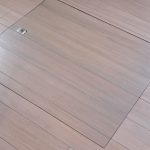
Refitting a door on board a yacht is the craft intervention that restores the surface, the finish and the functionality of the original element without replacing it. Doors in yacht interiors are bespoke components, integrated into the overall design of the vessel: replacing them almost always means high costs, long lead times and the risk of losing aesthetic continuity with the surrounding panelling and furnishings. Restoration, on the other hand, preserves the original element and brings it back to its initial condition.
In this article we explain how the Orazzini Refitting team approaches the refitting of a door directly on board, through a real case carried out by our mobile crew.
Why yacht doors deteriorate
Doors in yacht interiors are subject to constant stress. Opening and closing leaves its mark on the wood and on the high-gloss finishes. Exposure to light can cause localised colour variations, with visible differences between the door and the adjacent panelling.
The most frequent types of damage on an on-board door are: surface and deep scratches, dulling of the finish, chipping along the edges, localised dents and alterations to the original colour. To these are added functional problems: hinges that lose their smoothness, play in the closures, worn seals.
The stages of refitting a door on board
Work on a door follows a precise method, refined over more than 25 years in the field.
Inspection and diagnosis. Every intervention begins with an analysis of the actual condition of the element: type of substrate, nature of the existing finish, depth of the damage, condition of the hardware. The work plan is drawn up on the basis of this assessment.
Surface preparation. The surface is cleaned and prepared with calibrated sanding, respecting the thickness of the substrate. Deeper imperfections are treated with precision filling, worked by hand to obtain a perfectly uniform base.
Touch-up and rebuilding of the finish. On doors in fine wood, our craftsmen retouch the grain by hand with pigments and brushes, blending every correction into the surrounding material. The finish is then rebuilt in layers, until the original shade and degree of gloss are achieved.
Final polishing. Craft polishing completes the intervention and gives the door back its depth and uniformity of reflection, removing every trace of the work carried out.
Functional check. Hinges, handles and closures are checked and adjusted, to guarantee smooth, silent operation.
The real case: a door restored by the mobile crew
In a recent project, our team carried out the complete restoration of a door on board a yacht. The element showed the typical signs of daily use: a marked surface and a finish that was no longer uniform with the surrounding interiors.
The work was carried out entirely on site by the Orazzini Refitting mobile crew, without removing the door from its frame and without interrupting life on board. Once the job was completed, the door once again blended perfectly with the adjacent panelling, in both colour and finish — a result that replacement with a new element would hardly have guaranteed with the same aesthetic consistency.
As with the restoration of the washbasin and the refitting of tables on board, this intervention too demonstrates that the original elements of a yacht can be brought back to their initial condition through targeted craftsmanship.
The advantage of the mobile crew: the intervention reaches the yacht wherever it is
Orazzini Refitting operates with an itinerant mobile crew that carries out refitting directly on board, wherever the vessel is located. We have worked in more than 35 locations worldwide, serving over 125 clients including owners, shipyards and captains. For the owner this means shorter timescales, no transfer to a shipyard and targeted work on individual elements — such as a door — without bringing the cruising season to a halt.
If a door on your yacht shows signs of wear, scratches or alterations to the finish, contact us for an assessment: we will analyse the element and propose a tailor-made restoration plan, carried out directly on board.