

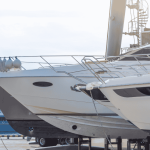
Orazzini Refitting’s refit philosophy is based on a non-negotiable principle: every intervention must restore the treated surface to its original condition, with no visible traces, no shortcuts, and no compromises on material quality. This is not a generic statement of intent, but the practical method the company has applied to every yacht refit project—from initial assessment to final delivery—for more than 25 years.
In the yacht refit industry, the difference between an acceptable result and an outstanding one is determined by what happens before and after the technical intervention itself. Preparation, intermediate quality control, material selection, and the time dedicated to each stage are the factors that distinguish true craftsmanship from standardized work. Orazzini Refitting has built its international reputation precisely on this difference.
What “Executional Excellence” Means in Yacht Refitting
Executional excellence in yacht refitting is the ability to carry out a technical intervention on a surface—wood, leather, paintwork, marble—in such a way that the result is indistinguishable from the original, both visually and to the touch. It is not a subjective aesthetic concept. It is a measurable standard: exact color matching, consistent surface texture, absence of processing marks, and long-term durability of the treatment.
This standard applies to every type of intervention. A touch-up on a lacquered panel must have the same color depth and gloss level as the surrounding areas. A leather restoration must restore softness and grain consistent with the original material. A repair on a dented surface must be imperceptible both visually and by touch.
In the high-end yachting sector, executional excellence carries an additional responsibility. Yacht interiors are designed by professionals according to precise color and material specifications. A refit intervention does not reinterpret those specifications—it respects them completely. Any deviation, however small, is a compromise, and compromises are not accepted.
The Operational Principles Behind the Orazzini Refitting Philosophy
Orazzini Refitting’s operational philosophy is built on five practical principles. These are not abstract values but rules that guide every technical decision made in the shipyard, at the marina, or onboard a yacht.
First Principle: Assessment Always Comes Before Intervention
No work begins without a complete analysis of the damage and its context. The specialist technician identifies the type of damage, determines the original materials, evaluates environmental conditions, and defines the operating plan. An intervention carried out without proper assessment may solve a superficial problem while creating a structural one.
Second Principle: Original Standards Are Never Replaced with Inferior Alternatives
If an intervention requires a specific pigment, a filler with particular elastic properties, or a marine-grade UV-resistant topcoat, that exact product is used. Replacing it with a cheaper or more readily available alternative is not considered. Professional products used in yacht refitting are formulated differently from residential products, and the difference becomes evident in the durability of the final result.
Third Principle: Every Stage Requires Its Own Time
A leather re-pigmentation cycle generally requires three to five coats with drying times between applications. A repair on fine wood involves progressive sanding with increasingly refined abrasives and visual inspection under raking light between each stage. Accelerating these processes may produce results that appear acceptable at delivery but reveal defects within weeks. Speed is incompatible with excellence.
Fourth Principle: Quality Control Is Continuous, Not Final
Quality is not verified only at the end of the process. Every intermediate stage is checked before moving on to the next. Cleaning is verified before substrate preparation. Filling work is inspected before pigmentation. Pigmentation is assessed before sealing. This sequential approach, with verification at every stage, eliminates the risk of an upstream defect compromising the final outcome.
Fifth Principle: The Intervention Must Be Invisible
The ultimate measure of quality is the complete absence of visible evidence that work has been carried out. If the intervention can be seen, it has not met the required standard. This applies equally to a touch-up on a deep scratch and to the repainting of an entire hull. The invisibility of the result is the benchmark by which Orazzini Refitting evaluates every project before delivery.
The Role of Craftsmanship in Contemporary Yacht Refitting
Today’s yacht refit industry is characterized by two distinct approaches: industrial and artisanal. The difference is not one of scale—an artisanal intervention may involve an entire yacht—but rather one of method and attention to detail.
The industrial approach standardizes processes. It relies on predefined color ranges, identical procedures for different materials, and fixed timelines regardless of context. It delivers functional and efficient results suitable for mid-range vessels, where cost control is often the priority.
The artisanal approach customizes every intervention. Colors are mixed individually using advanced color-matching systems to achieve an exact match with the original surface. Application techniques—whether hand-operated airbrushes, precision touch-up brushes, or specialized filling tools—are selected according to the material, the type of damage, and the required finish. The time devoted to each stage is determined by what the work requires, not by a standardized schedule.
Orazzini Refitting operates exclusively according to the artisanal approach. Founded by Riccardo Orazzini and Luca Orazzini and based in Perignano (Casciana Terme Lari, Pisa), the company chose from the outset to position itself in the high-end refit segment, where excellence is the only acceptable standard.
This choice comes with trade-offs: longer execution times, higher material costs, and the need for highly skilled personnel. However, it also delivers a result that industrialized processes cannot replicate.
The philosophy of excellence described in this article applies to the entire range of services offered by Orazzini Refitting, including yacht refitting for the restoration of interior and exterior surfaces, professional marine painting, and the restoration of fine materials. Orazzini Refitting’s Made in Italy approach—built on craftsmanship, attention to detail, and premium materials—reflects a manufacturing tradition that remains an internationally recognized benchmark within the yachting industry.